Amplify
 The other day I was tweeting something with a hashtag, and the 12-year-old rolled her eyes and said hashtags were for teenagers. I pointed out that it was adult users of Twitter that invented hashtags. She made that hashtag sign with her fingers, and then I rolled my eyes.

The thing about hashtags is that they can cause a tweet to take on a life of its own. So far in 2016, thanks to hashtags, I’ve had one tweet appear on news sites around the world and another show up on The Today Show. In each case, Twitter helped amplify a message that I thought was important. I’d like to share those messages (again) here on the blog, and provide a little backstory on each. As much as 140 characters can do, sometimes a little more context is useful.
Back in December 2015, Star Wars: The Force Awakens came out. Prior to that, the girls and I had watched five of the six prior Star Wars movies (unfortunately, not in Machete order); watched the entire run of the Clone Wars animated series, including the Netflix-only final season; and played through one of the Star Wars Lego games for the Wii. And then there was that Star Wars themed party back in 2014 you might remember. We are above-average Star Wars fans in my family.
We didn’t see The Force Awakens opening day (I didn’t think we could handle those lines) but we saw it shortly after it opened. All three of us loved it. Seriously, that scene where you first lay eyes on the Millennium Falcon? Our theater erupted in cheers, and we cheered right along with them. After the movie, I asked the girls who their favorite characters were. The 12-year-old, being 12, said somewhat shyly, “Han Solo.” The 8-year-old, who was then 7, answered quickly and firmly: “Rey!”
Yes, Rey. The plucky desert scavenger who (spoiler alert for a seven-month-old movie everyone has seen) turns out to be strong with the Force. And is, without a doubt, the central character in the movie. Sure, Han and Finn are major characters, too, but Rey is the one that drives the movie (and flies the Falcon). She’s the one (again, spoilers) who gets to take down the big bad at the end of the movie. Rey is Lily’s kind of hero.
Which is why I spent the next week searching Franklin high and low for a Rey action figure I could give Lily for Christmas. There were none. I don’t know how many toy stores I checked. The closest I could manage was a Lego set consisting of Rey and her speeder. Lily loved it, but it bugged me that I couldn’t find any other Rey merchandise. I found one Rey poster (in Michaels, of all places) in time for Lily’s birthday in January, but otherwise, I was left wondering #WheresRey?
Which brings me to the hashtag. That hashtag, #WheresRey, got a lot of use on Twitter in December and January. I wasn’t the only one wondering where all the Rey merchandise was. Some of us remembered the #WheresNatasha hashtag from a couple of years ago, referring to Natasha Romanova, better known as Black Widow. She got more screen time than any other character in the Avengers movie, yet she was consistently left out of Avengers toys and other merchandising. If you found an Avengers t-shirt back in 2012, it was a safe bet it featured a number of the male Avengers, but not the only female one. It seemed pretty clear that toy companies (a) didn’t think little girls wanted Avengers gear featuring Black Widow and (b) didn’t think little boys would want an “icky” girl on their Avengers t-shirts.
This trend continued with other movies. My favorite / least favorite example of this trend was the Big Hero 6 fabric available in craft stores in 2015. If you wanted to make a pillowcase or sheets featuring the heroes of Big Hero 6, you would have to settle for the four male members of the team. The two girls (Go Go and Honey Lemon) were left off. So, um, Big Hero 4? Ridiculous.
All this was in my mind when I kept seeing news about Rey being left out of The Force Awakens merchandise. There was the Monopoly game that featured Darth Vader, Luke Skywalker, Kylo Ren, and Finn… but no Rey. There was the Target action figure six-pack that included Finn, Chewbacca, and Poe Dameron… but no Rey. There was the Millennium Falcon toy that came with Chewbacca, Finn, and BB-8… but no Rey. (Seriously, a Millennium Falcon without either of its pilots?) One journalist searched the Disney, Target, and Toys R Us online stores and counted Star Wars merchandise. Bad guy Kylo Ren consistently appeared more often than Rey, twice as often at some stores!
Toy companies offered some reasons for Rey’s absence. Hasbro noted that including Rey in their Monopoly game, which came out three months before the movie, would have been a spoiler. Somehow they didn’t think including Finn as a good guy would be a spoiler, even though the movie trailer positions him as a Stormtrooper of unknown allegiance. Nor did Hasbro apparently realize that Rey was all over the posters for The Force Awakens. Other companies noted that Darth Vader was the best-selling character from the original movies, justifying the wide variety of Kylo Ren merchandise from the new movie. That makes business sense, but it doesn’t explain why Poe Dameron got more toys than Rey or why Rey was left out of sets (like the Millennium Falcon set) where it would make more sense to include her than not. Even J. J. Abrams, the director of The Force Awakens, thought her absence from merchandising was mysterious.
Why does all this matter? One reason is that there are plenty of little girls out there who, like my daughter, saw the movie, thought Rey was the coolest, wanted a Rey action figure, and couldn’t find one. We’ve had six Star Wars movies where a boy was the lead character. We finally get one where the girl saves the day, and she’s almost nowhere to be found in the merchandising. News flash, toy companies: Girls play with toys, too, and they want more than just Barbie dolls and Disney princesses. They want characters who take the lead and solve their own problems. (Don’t get me started on how useless Cinderella is when it comes to solving her own problems…)
The other reason this matters is what motivated me to use the #WheresRey hashtag that started appearing on Twitter. After spending December looking for Rey action figures and reading about the controversy, I tweeted:
Re: #WheresRey. It's not just that little girls need to see that girls can be heroes, it's also that little boys need that message, too.
— Derek Bruff (@derekbruff) January 5, 2016
There was something about the idea of thousands of kids, boys especially, watching the movie, seeing Rey kick butt and save the day, and then going home and recreating the movie with their action figures without the girl. How often are the contributions of girls and women in so many areas of our culture left out in favor of what’s accomplished by boys and men? Too often, and we shouldn’t be teaching our kids, especially boys, that this is okay.
I sent that tweet in January from my professional Twitter account. By including the #WheresRey hashtag, I joined an ongoing conversation on Twitter about this topic. The hashtag let others, who weren’t already following me, find the tweet and react to it. And, boy, did they react. Check out those stats: 359 retweets and 431 likes (as I write this blog post). On a good day, one of my tweets will get maybe 5 retweets and 10 likes. This one took off like wildfire. It’s been viewed more than 62,000 times so far. And, even crazier, it’s been quoted in at least half a dozen news articles around the world–in the US, in the UK, in Canada, in Brazil, and in Malaysia!
Flash forward to May 2016. I receive an email from my daughters’ school that the second graders don’t have to wear their uniforms on the last day of school. It’s a party day, so street clothes are fine. Except that girls can’t wear tops with spaghetti straps. This doesn’t make sense to me, so I wonder about the prohibition on Twitter. My friend Becky responds with a link to a news item about a North Carolina school district that recently banned skinny jeans and leggings. Now, we can debate the merits of school dress codes, but the reason given for this particular ban is particularly problematic:
A local news station reported that New Hanover County School Board Vice Chair Jeannette Nichols said, “One of the reasons behind the policy change was that some of the ‘bigger girls’ were getting bullied because of their tight jeans.”
This is an example of what’s sometimes called victim blaming. I hear it too often in cases of sexual violence on college campuses. A woman is attacked, and someone says that she was basically inviting it given what she wore or how she behaved. Let’s be clear: If a man attacks a woman, it’s the man’s fault, not the woman’s. Blaming the victim only makes it harder for survivors of sexual violence to come forward, get help, and seek justice. And here’s New Hanover County school district banning skinny jeans because girls wearing skinny jeans are getting bullied. I went to Twitter with my reaction:
Dear @NewHanoverCoSch, if "bigger" girls are getting bullied because of their tight pants, ban the bullies, not the pants. #policy8520
— D. Bruff (@drkbrf) May 20, 2016
Now this tweets has only been viewed 5,000 times. But, since I used the #policy8520 hashtag, when The Today Show did a story on the dress code and went looking for perspectives on Twitter, they found my tweet. And they used it on air! A quick-thinking friend (thanks, Lisa!) sent me a screen capture:
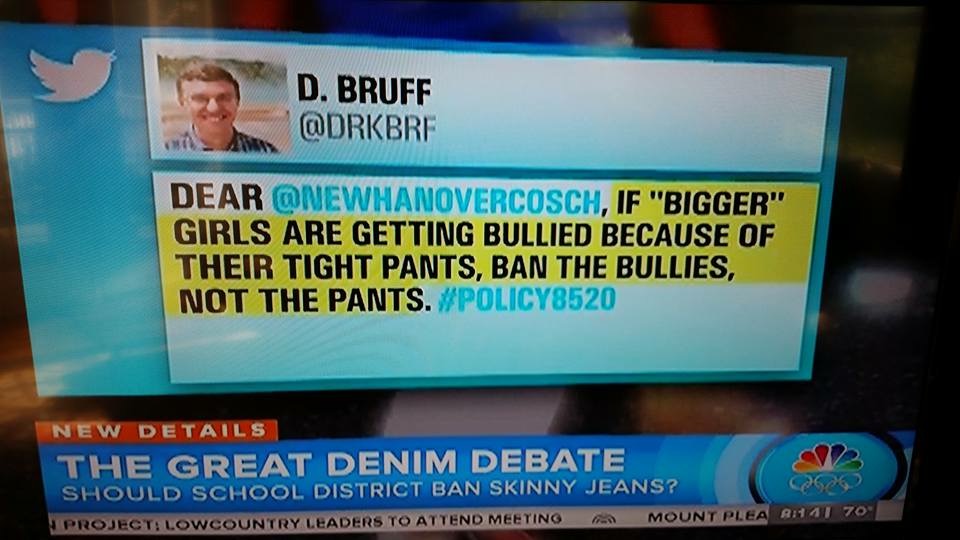
Becky was the first to alert me to my Today Show appearance. I was actually in New York City at the time, for work. I joked that they could have interviewed me while I was in town. By the time I opened Facebook later that day, my friend’s post with the screen capture had gotten about 50 likes. I was Today Show famous.
Seeing these tweets get the attention they did was exciting, certainly, but, more importantly, Twitter provided a way for a couple of messages I find important to reach a wider audience. When composing both of these tweets, I had my daughters in mind. I thought about the world they live in, the world they’ll experience as they get older and leave the nest. Frankly, it’s a scary world. As much as I like to think that they’ll do just fine out there, I’m aware of the dangers, of the many, many ways they might be mistreated in this world. I can’t protect them from all frustrations and threats they’ll encounter, but I can try and I can do my part to make this world one where girls and women are treated with respect and dignity.
Sharing opinions on social media sometimes seems like the least effective way to make change in the world. Certainly, tweets and Facebook posts don’t seem to be changing minds during this political season. But sometimes, a “trending” hashtag can make a difference. Hasbro has announced that new versions of their Star Wars Monopoly game will include Rey, a move they made in direct response to the #WheresRey outcry on Twitter. Lily and I were thrilled a few weeks ago to find a set of Star Wars action figures at Target that included Rey, and she now sports a Rey t-shirt (her favorite) that we found at Target recently.
I haven’t heard if the New Hanover County school district has revised their ban on skinny jeans, but I know that toy and other merchandise companies are responding to #WheresRey. I think gender representation in kids’ toys matters, and, at least in this area, a well-worded tweet with the right hashtag can help make a difference. So, as a dad of two daughters, I’ll keep tweeting.
Image: “megaphone head man,” looking4poetry, Flickr (CC)