Where the Buffalo Roam – Our Wyoming Adventure, Part Five
As I’ve mentioned before, I’ve learned that when traveling with the girls, as long as each day involves animals of some kind, they’ll be happy. During our first evening in Yellowstone, we saw elk, bison, grizzly bears, and a bald eagle. After that wildlife bonanza, I figured we could coast a little the next day. We did, but, man, Yellowstone delivers, even when you’re not trying very hard.
We were spending two nights in a row in West Yellowstone, so I decided we would do breakfast in the hotel room to save a little money. That mean hitting the grocery store first thing, since it had been too late to do so when we arrived the night before. We loaded up on breakfast and lunch items, since I predicted a picnic lunch later in the day, then headed back to the hotel to eat.
While we were in the grocery store, the girls’ mom called to speak with the kids for the first time since we left Nashville. That went fine, except that she admonished me to take photos of the girls, not just of the places we were visiting. That bit of advice was a flashback to a decade ago, when film cameras meant there was a trade-off between the two — and before I really took up photography as a hobby. It bugged me a little, but darnit if I didn’t make sure to take photos of the girls at every major attraction the rest of the trip.
After breakfast, we visited the Grizzly and Wolf Discovery Center, just outside the park entrance in West Yellowstone. Seeing a wolf in the wild at Yellowstone is next to impossible. There are less than 100 that live in the park, and, except for the winter months when they’re more active and show up against the snow, they are hard to spot. Not so at the Grizzly and Wolf Discovery Center, however, where half a dozen wolves are kept and cared for. The Center provides a home for a number of animals whose injuries prevent them from living life in the wild. For a couple of girls who were, at one point, determined to be “animal rescuers” when they grew up, this was a can’t miss stop on our tour of Yellowstone.
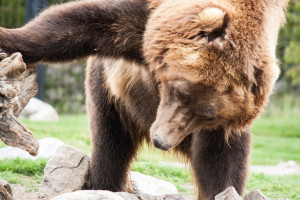 The wolves were beautiful, but spent the entire time napping. The highlight of our visit to the Center was grizzly bear feeding time. In the Keeper Kids program, kids learn about grizzly bears, then hide treats for one of the bears while he’s away. Then the kids leave the bear enclosure, and the bear re-enters to turn over logs and stones to look for his treats. We didn’t arrive in time for my girls to participate, unfortunately, but we still enjoyed watching one of the big guys (Ben, I think his name was) as he nosed around for food. We took appropriately silly photos of the girls in the (inactive) bear traps on display, and we enjoyed seeing the other animals, mostly birds of prey, on display. (In case you’re keeping track, the eleven-year-old’s favorite animal is still the peregrine falcon.)
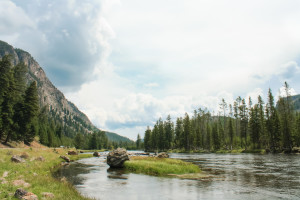 As we entered the park itself, the sun started peeking out from behind the clouds. We stopped to take photos of the magnificent landscape, as we would do several times that day, then made our way to the Madison ranger station. We had two days for the girls to get their Yellowstone Park Junior Ranger badges, and it was time to get started! The girls learned they would need to attend a ranger talk, so we strategized. Rumor had it that the ranger on duty at the Madison station the next day was crazy about wolves, so that talk would probably be awesome. But there was a campfire talk later that night in Norris that would be fun, too. We figured we had a couple of good options.
From Madison, we headed northeast, in the general direction of Lamar Valley, which had the best wildlife, according to my guide book, the park rangers, other visitors, and probably Teddy Roosevelt, too. I was a little worried about getting too close to wildlife, after a few stories about charging elk from the Madison park ranger, but I wanted to see what we could see there. I figured we had enough time to see a bit of Lamar and circle back to our hotel before bedtime, although driving times were hard to estimate in Yellowstone.
Not far from Madison, we passed Gibbon Falls, a waterfall we ended up driving past, but not actually seeing, three times during our vacation. We tried to stop and see it this Wednesday morning, but there wasn’t any parking, so we moved on. We decided that the waterfall was either named after some guy named Gibbon or after all the gibbons that lived in the area. Our second hypothesis was far less likely, but funnier, so we went with it. Since we didn’t see any gibbons, we assumed they were invisible, which is why invisible gibbon jokes were made throughout the rest of our stay in Yellowstone.
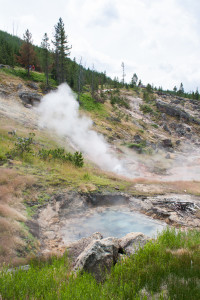 We didn’t stop at Gibbon Falls, but we did stop at the Artists’ Paintpots, just up the road. I wasn’t entirely sure what the Artists’ Paintpots were when we stopped, but I suspected they were some kind of interesting geothermal feature. The sign next to the parking lot indicated that trail that looped around the paintpots was about a mile, which I figured we could handle — not realizing that the seven-year-old hadn’t been drinking water all morning like I had asked. She conked out a couple hundred yards down the trail, but I was determined to find out what the paintpots were, so I hoisted her on my back and pressed on.
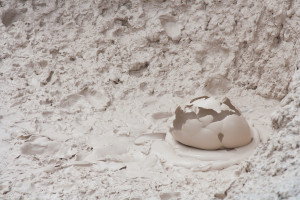 The girls had a few “should we just turn back moments” on the short trail, but, when we finally saw the paintpots half a mile later, we were all glad we had persisted. They were indeed geothermal features, mudpots to be precise. Each looked like a bubbling mud puddle, maybe eight to ten feet in diameter. Heat and steam from below kept the mudpoint bubbling, day and night. Each mudpot was a different color, and, while the colors weren’t as vibrant as “Artists’ Paintpots” might lead to you to believe, they were still fun to watch. And you could feel the heat from the boardwalk, ten feet away. Our first close encounter with a Yellowstone geothermal feature was worth the hike!
By the time we returned to the car, we were all overdue for hydration — and lunch. So we headed up the road to the picnic table icon I saw on the map. It was next to something labeled Virginia Cascade, which sounded promising. I was tempted to fit in a visit to the Norris Geyser Basin along the way, but lunch seemed more important, so we skipped it, knowing we might see it that evening on the way back. The Virginia Cascade wasn’t the most impressive waterfall we saw in Yellowstone, but it was pretty and it made for a sonically pleasing backdrop for lunch. We ate lunch sitting on the ground, which was fine, until we saw a bunch of picnic tables just half a mile up the one-way road. The picnic tables were empty, but there were three other groups picnicking on that patch of ground where we had lunch, so I’m thinking there should have been a “Picnic Tables That Way” sign somewhere.
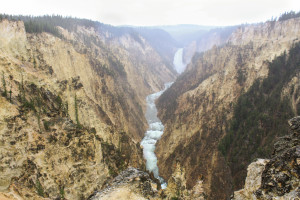 Next up was one of Yellowstone’s must-see sights, the Grand Canyon of Yellowstone. Some people there just called it the Grand Canyon, but after visiting Grand Canyon Actual in 2013, we knew better. The Grand Canyon of Yellowstone isn’t nearly as big as the real deal, but it sure was pretty, even in the pouring rain. Had the girls not been cold and wet, I would have stayed longer, taking in the view, but, as it was, I grabbed as many photos as I could, then zipped back to the car to wait out the storm. Actually, that’s not quite right — I made sure to get a shot of the girls shivering under the branches of a big tree we found. Gotta get photos of the girls, right?
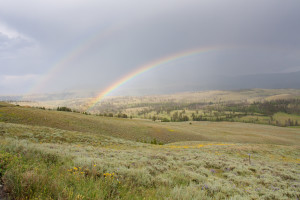 We killed half an hour in the car waiting for the rain to pass. I believe there were invisible gibbon jokes involved. I was bummed at the weather, since I was hoping for more magnificent vistas, but we pressed on, taking the road way, way up through Dunraven Pass. That’s 8,859 feet above sea level, I believe the highest point we reached the entire week in Wyoming. It’s a bit of a white-knuckle drive, what with the no-shoulder, two-lane roads twisting and turning. Just after Dunraven Pass, on the north road to Tower Falls, the view opened up at the same time the rain ended, leading to one of the brightest rainbows I’ve ever seen. We stopped at a pullout, and Lily and I hopped out to take photos. It’s hard to do justice to a rainbow in a photo, but these shots came close. It was quite a moment for me and the kids, seeing that amazing rainbow arcing across the green Yellowstone landscape.
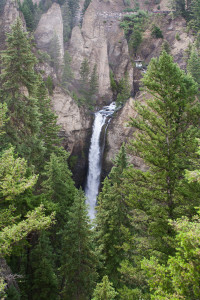 We made a quick stop at Tower Falls, which was the most impressive waterfall we saw in Yellowstone. Then I made one of the toughest decisions I made all week. We had two choices: start heading back toward West Yellowstone and catch that campfire talk back in Norris or head east to the Lamar Valley and try to see more wildlife. We didn’t have time to do both. Hannah wanted to try the campfire talk, I wanted to press on to Lamar Valley, and Lily was agnostic. Remembering that everyone and his brother had recommended Lamar Valley, I made the executive decision to head east. I told myself that we would give it twenty minutes, and, if it didn’t seem promising, we would turn around and just maybe make it to Norris in time.
About eighteen minutes later, we came upon an entire herd of buffalo, just on the side of the road.
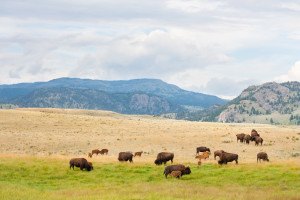 It was at that moment I realized just how amazing Yellowstone is. In one relatively small corner of Wyoming, one can see magnificent landscapes, fascinating geothermal features, and the biggest mammals North America has to offer. Later in the trip, we learned about mountain man John Coulter, one of the first Europeans to explore this part of the country. After visiting what we now know as Yellowstone, he tried to tell his fellow trappers what he had seen. They didn’t believe him. Herds of buffalo? Waterfalls that fell up? They thought he had gone crazy. But he hadn’t. Yellowstone is just that amazing.
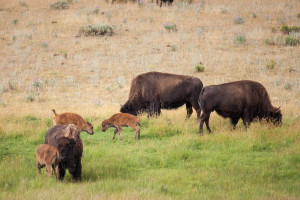 We spent a good half hour watching the buffalo. We probably took two hundred photos between the three of us. We kept our distance — those ranger stories stuck with me — but we watched and watched. The calves were the best part, running around full tilt and play fighting each other. But the big males, they were impressive. They’re the largest living land animals in the Americas. There were maybe eighty buffalo in the herd, spread out across this little patch of Lamar Valley. There aren’t many places left in the world where you can see that many buffalo together in the wild.
I made the right call. The girls and I will never forget seeing that herd of buffalo.
After spending some time with the buffalo, we headed west toward our hotel. It was more than two hours away. I knew the sun would be setting soon, and I didn’t want to drive in Yellowstone after dark if I could help it. We sped along the north loop, making just one short stop in Mammoth (known for its hot springs) for a bathroom break. Just before that stop, I made another one of the toughest decisions of the trip, although this one only affected me.
The sun was setting, shining a golden light over the park. We came down into the valley surrounding Mammoth and crossed a bridge high over a river gorge. I saw a number of cars stopped on the far side of the bridge, their passengers out taking photos. As we drove over the bridge, I glanced over my shoulder to see what they were shooting. It was the most beautiful landscape I had ever seen — mountains and valleys in stark contrast, glowing in the evening sun. I looked at my watch, and, with a grimace, decided to keep driving. There was no time for a photo op.
Today, two months later, I still regret not taking five minutes to shoot that scene.
Oh, we might go back one day. Certainly, there’s plenty to see and do in Mammoth that we missed out on during our speedy trip home that night. And we never made the campfire talk or saw the geyers in Norris. But catching the light just right on that majestic scenery just east of Mammoth? I don’t know that I’ll be that lucky again.
That night, while the girls and I were eating dinner like mountain men back in West Yellowstone, I remembered that we were due to see the Grand Tetons in two days. I wouldn’t make the same mistake twice — if there was a photo op, I would take it. And I did.